IBC shares the most relevant developments in the sector, from the defence of independent journalism to the latest achievements in artificial intelligence, live production, and new audiovisual experiences. The organisation continues to drive innovation and encourages the industry to take part in IBC2026.
Press freedom faces one of its most critical moments
IBC highlights that this year's Rory Peck Awards once again revealed the serious threat facing press freedom. Held at the BFI in London and hosted by CNN journalist Christina Macfarlane, the event underscored that upholding truth has become an increasingly difficult battle.
The organisation behind the awards, dedicated to supporting freelance journalists around the world, has already assisted more than 3,500 reporters with training, resources, and funding to continue telling essential stories from the field.

IBC reviews the sector’s key technological milestones
The AI Agent Assistants for Live Production project, developed within the IBC Accelerator programme, won the Best AI Innovation (Workflow) award at the Broadcast Tech Innovation Awards 2025.
During the ceremony, held before 450 attendees at The Brewery in London, the project was recognised for “totally transforming how people and artificial intelligence work together”, strengthening IBC’s commitment to advanced hybrid models in live production.
The project—driven by broadcasters such as BBC, ITN, and Channel 4, alongside technology companies including Google Cloud, EVS, CuePilot, Shure, and others—addresses one of the biggest challenges in production control rooms: operational complexity and the reliance on multiple interfaces.
To solve this, the team developed a voice-controlled assistant director based on an open and vendor-agnostic system that integrates technologies such as Gemini to coordinate workflows between specialised agents. The POC successfully executed a live news gallery fully assisted by AI, with agents dedicated to audio, automation, graphics, content, rundown, music, TX, and video enhancement.
The project was presented at IBC2025 in Amsterdam, where it demonstrated how this architecture reduces complexity, speeds up decision-making, improves quality, and protects trust in live production—always with a focus on AI as human support, not as a replacement.
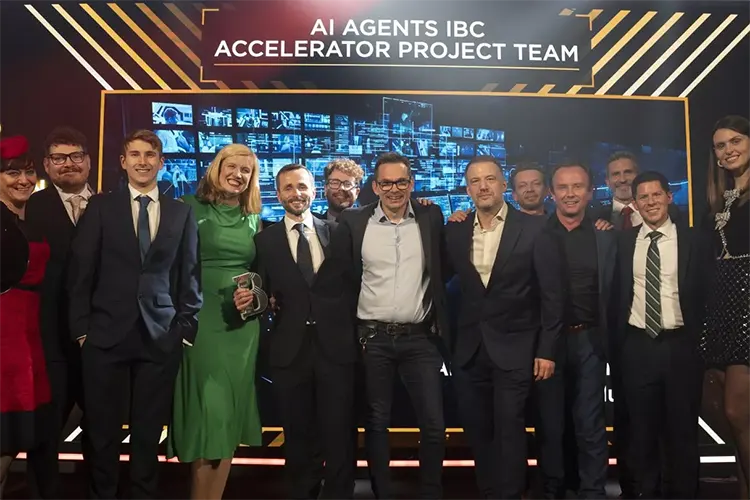
This diverse and talented group exceeded what true collaboration means, combining resources, skills, and a strong curiosity for R&D innovation, highlighted Muki Kulhan, Lead of IBC Accelerators.
Alongside the project’s main award, the Broadcast Tech Innovation Awards 2025 also recognised numerous professionals and companies in categories such as creative AI, post-production, sustainability, VFX, graphics, young talent, and outstanding technology in production and post-production.
‘Accelerating Innovation’ Podcast
IBC explores the shift of live broadcasting to the cloud with a new episode, Master Control Cloud, from the IBC Accelerating Innovation Podcast.
Recorded during IBC2025, the episode brings together experts from the Master Control Cloud project, who analyse how broadcasters can eliminate on-premise dependencies without compromising the accurate delivery of content to every channel and destination. The episode examines the keys to building more flexible, distributed, and resilient architectures.
The disruptive forces transforming ‘Content Everywhere’ in 2025
The Content Everywhere ecosystem continues to evolve, driven by new AI applications. According to the analysis presented by IBC, 2025 is shaping up to be the year in which companies begin applying artificial intelligence in a more selective and strategic way.
For André Rosado, Head of Product at Agile TV, “the real disruptor is not AI alone, but what AI has unlocked”. This approach opens opportunities in automation, cost optimisation, personalisation, and improved performance across video and streaming platforms.
IBC opens submissions for the ‘Accelerator Media Innovation Challenges 2026’
IBC has officially opened submissions for the Accelerator Media Innovation Challenges 2026, inviting media and entertainment organisations to propose collaborative challenges that drive technological innovation across the sector.
The programme, now in its eighth edition, continues to be an international benchmark in applied experimentation, bringing together broadcasters, studios, streaming platforms, content owners, gaming companies, technology providers, startups, and academic institutions to solve real-world challenges through rapid development and practical demonstrations.
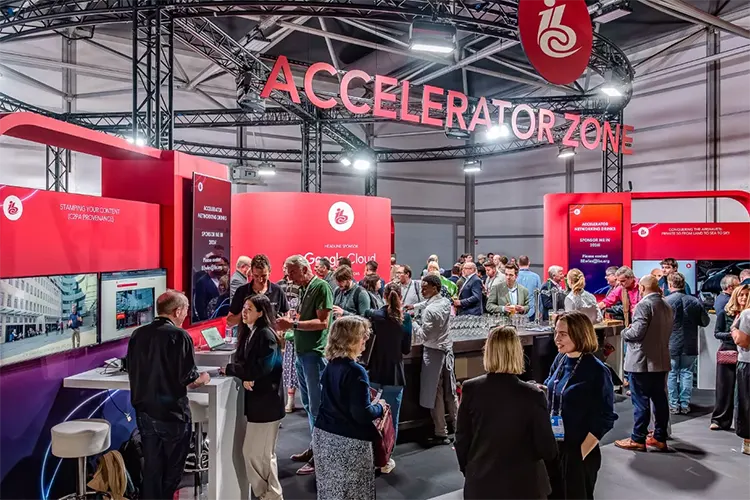
IBC will select up to 12 challenges to advance to the on-stage pitch round during Kickstart Day, to be held on 25 February 2026 at the BBC Radio Theatre in London. The event will feature strategic keynotes and discussions on technology trends.
Afterwards, final projects will be chosen and developed between March and August, culminating in live proof-of-concept (PoC) demonstrations during IBC2026, from 11 to 14 September in Amsterdam.
The challenges may cover key areas such as AI, connectivity, immersive media, cloud workflows, content distribution, virtual production, content provenance, cybersecurity, or sustainability.
The Accelerator Programme is a unique platform that fosters real collaboration and experimentation. Each year, new practical innovations emerge that are applied to real-world use cases, and we look forward to seeing the challenges that will define the 2026 edition, said Mark Smith, Chair of the IBC Council.
In its seven-year history, the programme has delivered more than 50 proof-of-concept projects involving over 400 organisations. In 2025 alone, nine pioneering initiatives were presented, covering areas such as AI agents, generative AI, ultra-low latency streaming, cloud-native workflows, private 5G, and sustainable content distribution.
Automated ‘fancam’ production with AI and 8K
The Technical Paper 2025 presents an innovative development by KBS and NHK, who demonstrated a fancam workflow based on artificial intelligence using 8K cameras alongside the VVERTIGO pipeline.
This system enables the automatic creation of personalised content, eliminating the need for complex multi-camera setups. It also improves facial identification accuracy thanks to the KBS6700 corpus, significantly optimising the entire production chain.
IBC reaffirms its role as a driving force for innovation in the industry, advancing new technologies, supporting journalism, and promoting collaborative projects that are shaping the future of media and entertainment.