
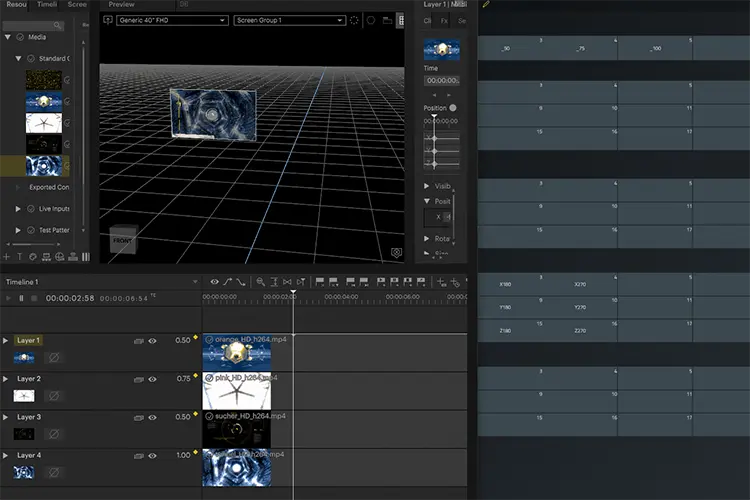
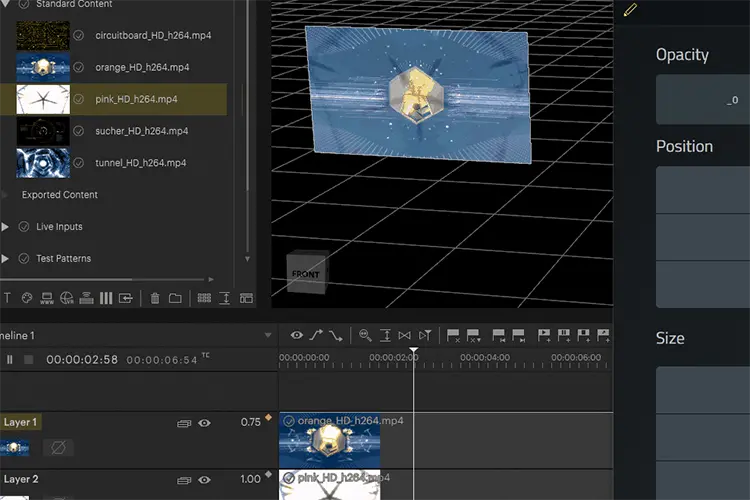
Pixera thanks to its new update 2.0 positions itself at the forefront of video design, visualization, and mapping software, offering a range of innovative improvements and features that transform the experience of industry professionals.
This updated version takes a qualitative leap in functionality, efficiency, and creativity, opening up an almost infinite range of possibilities for projects.
 |
 |
Below are the main features and improvements that Pixera 2.0 introduces:
- Multi-User: allows simultaneous collaboration on a project with synchronization of specific changes or continuous updates across all systems.
- Offline Programming: creates simulated system configurations, independent of real hardware, allowing for advance show preparation and the allocation of IP addresses for live systems as needed.
- Backup: detects failures and allows another director to take control, ensuring that all Directors are up-to-date and ready to replace a system in case of failure.
- Perspectives for screen groups: each screen group can have its own set of perspectives, determining how layers are viewed across screens.
- DMX Recording: efficiently records incoming DMX data, filtering noise and creating timeline clips that replicate DMX input.
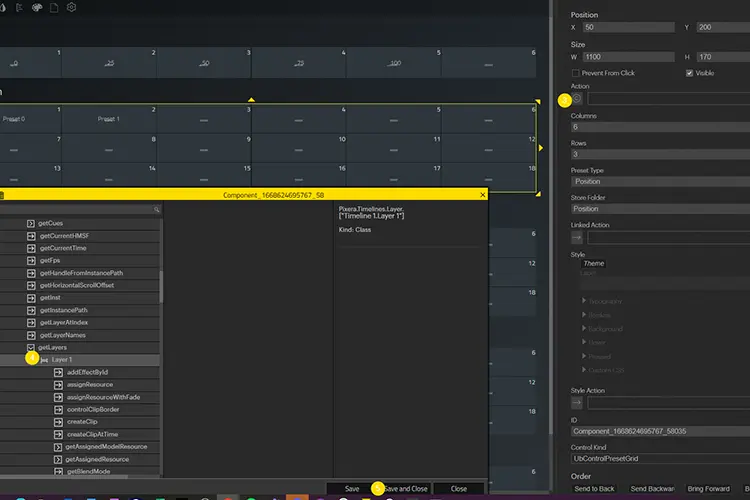
- Control Presets grids: offers presets for a wide range of PIXERA content, making it easy to select and apply effects and settings.
- Hot regions SMPTE: defines ranges of timecode in which a timeline responds to SMPTE input.
- Layer mapping effects: provides complete freedom to map content pixels to screens based on screen positions in space.
- Unreal Engine 5.2: provides support for Unreal Engine version 5.2 when used as a compositing resource.
- Position-dependent camera calibrations in the Studio: associates different positions with 2D corrective deformations of camera output for precise calibration.
- Automatic color calibration: automatically adapts LED output so that studio cameras capture correct colors in a virtual environment.
- Timeline speed: allows smooth adjustment of speed for an entire timeline.
- LTC Audio: receives Longitudinal Timecode (LTC) directly from the audio input card of a server.
- File versioning: manages different versions of content assets through the PIXERA user interface.
- Preview Camera: saves and animates different viewpoints in 3D space, with output via NDI.
- Control API Browser: a user interface for quick exploration and configuration of control actions for use in UI builder interfaces and Lua scripts.
- Tracking control integration: incorporates native integration of tracking protocols like SPNet, BlackTrax, TrackMen, Opti-track, MoSys, FreeD, Stype, and PSN.
- Heat maps: calculates LUX values for screens based on projector data and their position in 3D space.
- GUI Lock: creates a code to lock and protect the user interface from unwanted changes.
- Content encryption: allows PIXERA to encrypt content so that it can only be played back by the engine itself.
- Custom test patterns: individually adjusts test patterns for pixel deformation and mapping.
- Multi-resource: handles a split resource as if it were a clip.
- Polygonal deformation: creates different shapes in outputs and applies additional deformations to them.
- Audio over clients: plays audio files on the sound cards of other clients, with up to 128 channels of audio per client.
- Reference layer: assigns a resource to a layer and then uses it as a texture on multiple other layers in your project, with minimal additional rendering processing.
The new Pixera 2.0 update, with these improvements and features, establishes itself as an even more powerful and flexible tool for video mapping and visualization professionals, offering advanced solutions for a wide range of creative and technical applications in the audiovisual industry.