



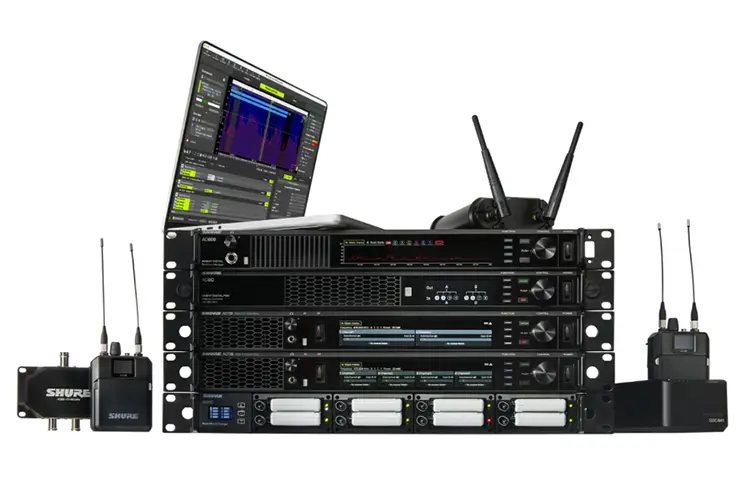
Shure has announced the upcoming release of a firmware update for its Axient® Digital PSM in-ear monitoring system, with availability scheduled for mid-May.
The update introduces new features aimed at optimizing radio frequency (RF) performance, improving signal stability in complex environments, and facilitating operational control in large-scale live productions.
The main innovation is the addition of the SC Narrowband transmission mode, a fully digital RF solution designed to combine the spectral efficiency of digital environments with the proven robustness of analog FM. This new mode has been developed for scenarios where the presence of metallic elements —such as stage structures or cymbals— can cause reflections, interference, or signal loss. In this context, Shure positions this enhancement as a response to one of the most common challenges in live RF management.
In addition, the update introduces improvements to CueMode, the tool used for monitoring multiple performer mixes. From this version onward, CueMode will support all ADXR transmission modes, enabling more agile and centralized supervision of different signals during a show. This adjustment responds to the growing complexity of monitoring environments, where multiple systems and configurations operate simultaneously.
From an operational standpoint, Shure notes that installing the new firmware will require two separate processes per ADXR bodypack, with an approximate duration of 30 minutes per device. The company recommends planning these updates in advance, particularly in touring or continuous production environments, to avoid workflow disruptions.
Real-world applications and use cases
The announcement of this update is supported by several recent cases demonstrating the system’s performance under demanding conditions. One notable example is its deployment at the All Points East festival in London, where the project of artist Barry Can’t Swim featured a full band, an orchestra, and two independent monitoring systems operating simultaneously.

This setup took place in one of the most congested RF environments in Europe, presenting a significant challenge in terms of spectral coordination and signal stability. According to the information provided, the Axient® Digital PSM system handled this configuration without dropouts or signal loss, maintaining consistent performance both during the festival and throughout the subsequent tour.
Another key scenario was the 2026 GRAMMY® Awards, where Axient Digital Wireless and Axient Digital PSM systems once again formed part of the technical backbone of live performances. In this context, other Shure devices were also used, such as the Nexadyne 8/S and the SM39 headset microphone, further reinforcing the brand’s presence in high-level productions.
Industry event presence
Alongside this update, Shure has confirmed its participation in Hellfest 2026, one of the most prominent music festivals in the European circuit. The company will have a dedicated space in the public area of the event, where it will showcase its live sound solutions, and will also maintain a backstage presence, providing technical support to engineers, technicians, and musicians.
This dual presence reflects a strategy focused both on product demonstration and direct engagement with professionals in real working conditions, aligning with the practical approach that characterizes these types of events.

Ongoing evolution of the technology ecosystem
The Axient® Digital PSM update is part of a continuous cycle of improvements within Shure’s software and firmware ecosystem. Recent versions include Axient Digital Firmware 1.5.4, Wireless Workbench 7.8.1, and Shure Update Utility 2.8.15, as well as updates to the SLXD system, now at version 1.4.7 with SLXD+ compatibility.
Additionally, SLXD+ transmitters and receivers are at version 2.0.38, consolidating interoperability within the brand’s networked systems. Shure recommends keeping all devices up to date to ensure compatibility between equipment and to guarantee optimal performance in professional production, broadcast, and live sound environments.
With this update, the company reinforces its focus on operational reliability and its ability to adapt to increasingly complex production environments, where efficient RF spectrum management and system stability are critical factors.