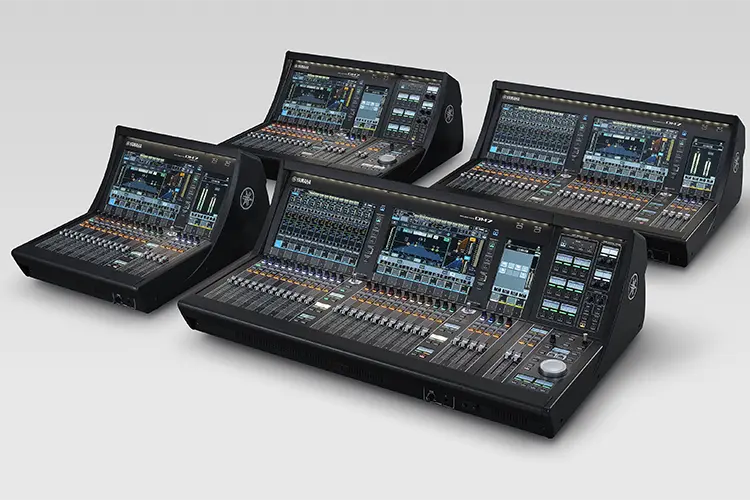
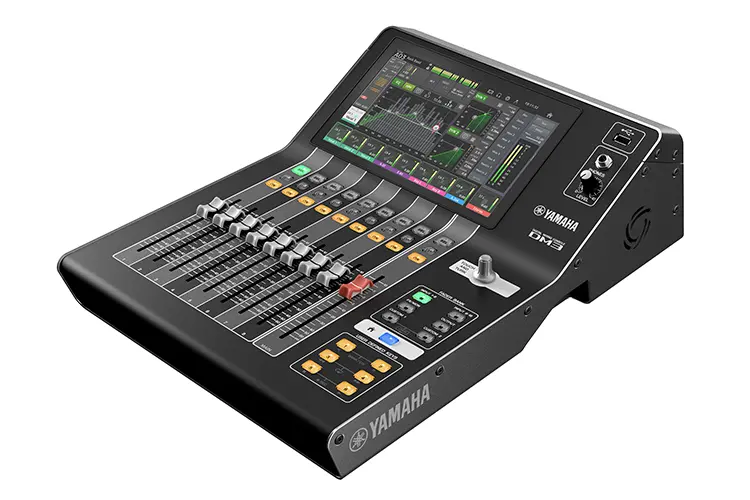
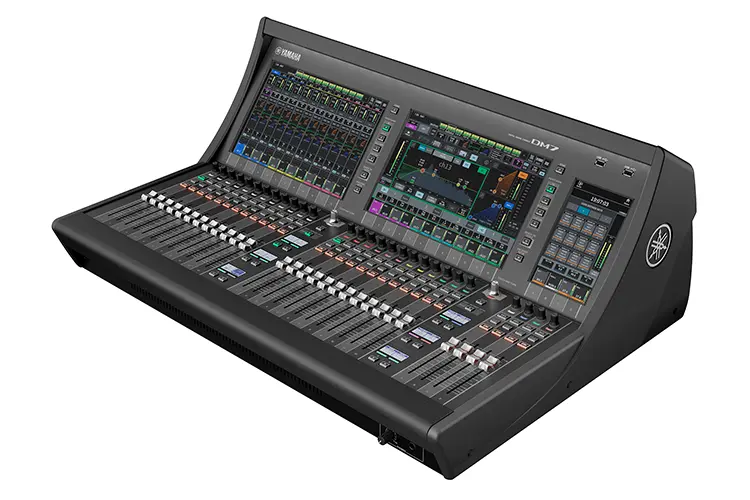
Yamaha has introduced several updates for its DM7 and DM3 digital mixing consoles which, taken together, point in the same direction: making it easier for systems of different sizes to share workflows, show data and network-connected devices.
Rather than simply adding new features, the updates are particularly relevant for rental, touring, broadcast and installation applications, as they address common situations such as moving a show from one console to another, reorganising channels with limited preparation time, modifying Dante patching while retaining certain settings, or controlling external equipment directly from the console surface.
Moving a show between DM7 and DM5 without rebuilding it
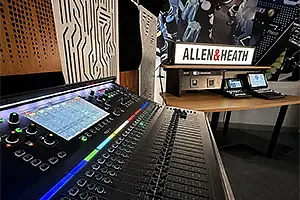
The DM7 V2.0 firmware adds compatibility with the new DM5 and DM5 Compact. Both families share the same operating philosophy and workflow, while DM Editor supports compatible console files between DM5 and DM7, making it easier to exchange data between the two platforms.
For a touring or rental company, this can be useful when a production does not always use the same console surface. A show prepared on a larger system may later need to be transferred to a more compact configuration without having to rebuild much of the work from scratch.
Yamaha has also unified part of the software ecosystem around both families: DM StageMix replaces the previous DM7-specific application and supports both DM7 and DM5, while DM Editor provides a common editing environment.
Changing patching without losing preamp settings
One of the most practical improvements directly affects patching. The new Take From Channel function allows an input assignment to be changed while retaining the existing head amp settings. In complex Dante systems, this can avoid having to rebuild gain and configuration settings when a source changes port or the system is reorganised.
The patch menu now also displays the Dante Port ID and port label, making it easier to identify sources and destinations within networks containing numerous devices. These may be small changes compared with the launch of a new console, but they can save time during system setup.
Fewer steps during mixing
DM7 V2.0 also introduces several changes aimed at everyday operation. The new Dynamic Mode for User Defined Knobs allows their functions to follow the module selected in Selected Channel. This enables the User Defined Knobs to control the parameters corresponding to whichever module is currently highlighted.
The operation of Sends on Fader, channel organisation and various bus- and send-related functions have also been revised with the aim of streamlining setup and mixing.
The focus here is not so much on adding new audio capabilities as on reducing movements and screen changes during real-time operation.
Controlling more equipment directly from the console
Another important part of the update is the expanded range of third-party Dante devices that can be integrated with DM7 and DM5.
Newly supported equipment includes devices from Audio-Technica, DirectOut and STAGETEC, expanding an integration ecosystem that enables certain monitoring and control functions to be performed directly from the consoles. Yamaha also lists support for Shure SLXD4+ and SLXD4D+ receivers.
The practical aim is to allow certain monitoring and control functions to be carried out directly from the console, reducing the need to constantly switch between different applications and interfaces during a production.
In increasingly heterogeneous systems, this interoperability can be particularly relevant when devices from different manufacturers need to work together.
More flexible I/O for DM7 and DM3
The updates also add support for the new Yamaha RUio1608SB-D, RUio0804-D and RUio16FLX-D units, expanding input and output possibilities via Dante.
For the DM3, V3.1 firmware adds support for the RUio1608SB-D and RUio0804-D and integrates the Ri8 and Ro8 units into the console's Dante Auto Setup function. In addition, the RUio16FLX-D allows remote head amp control from the DM3 when its inputs are patched to the console.
The Dante Auto Setup function automatically configures certain Dante settings and patches for compatible Yamaha devices. This can be particularly useful in small live sound systems, mobile recording setups or installations where reducing the time required to deploy a basic network is important.
Interoperability is becoming as important as performance
The updates reflect an increasingly important reality in professional audio: the console no longer operates in isolation.
Wireless microphones, remote preamps, interfaces, processors, stageboxes and Dante networks are all part of the same system. As a result, the speed with which an operator can identify, configure and control these elements is becoming increasingly important within the workflow.
For rental and touring applications, there is another factor: systems constantly change in scale. The ability to reuse files, maintain the same operating logic and transfer configurations between different surfaces can reduce preparation time and errors when a production moves from a theatre to a festival, from a compact system to a larger one, or from a local setup to a tour.
In this context, the DM7 and DM3 updates are noteworthy less for the number of new features than for a shared objective: enabling the console, network and I/O to operate in an increasingly integrated way within a single production environment.