Barix will showcase its latest professional Instreamer and Exstreamer devices for Audio over IP transport across broadcast and media networks at NAB Show 2026, with a strong focus on format diversification to suit a wide range of scenarios and customer preferences.
The Audio over IP pioneer will prioritize flexible parameters and configurations for its MultiCoder M400 and LX400 FLEXA codecs, as well as for its globally deployed Reflector Evo cloud transport platform.
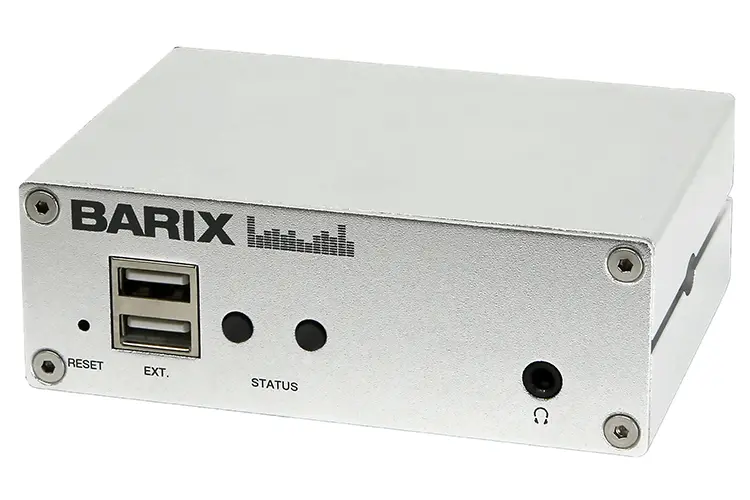
New for NAB, Barix has added support for SRT and RIST to its low-latency, multi-format MultiCoder M400, an IP encoder capable of sending audio streams to receiving points in four different formats.
This flexibility has proven highly attractive for use in broadcast headends, media production centers and remote service providers delivering content across diverse architectures. It is also the industry’s first SRT or RIST encoder available for under $500, representing a highly competitive price point for all budgets.
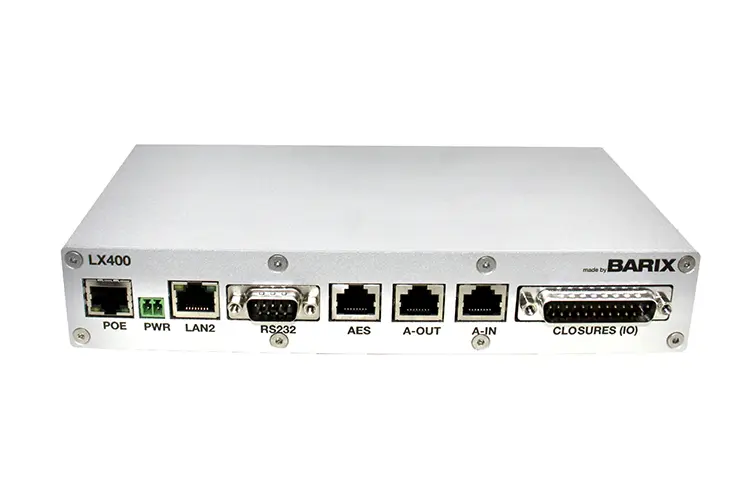
The addition of SRT and RIST to the MultiCoder builds on the recent introduction of SRT transport support in the LX400 codecs, Barix’s next-generation secure transport device designed for broadcasters. Key features include the ability to configure the LX400 as either an encoder or decoder for deployment over traditional studio-to-transmitter (STL) IP links, point-to-point SRT connections, or within a multi-point enterprise network based on the Reflector Evo cloud.
SRT and RIST offer similar benefits as open, interoperable and robust transport protocols for secure, low-latency live streaming over the public internet and unmanaged networks. The addition of these protocols is primarily about giving our customers freedom of choice in this new generation of Barix hardware devices, says Reto Brader, CEO of Barix.
The MultiCoder M400 is designed to deliver maximum flexibility and scalability across different network streams. The device integrates four internal encoding engines capable of simultaneous operation, each supporting low-latency protocols such as RTP, BRTP, SRT and RIST. This innovation enables encoding of incoming audio from connected analog sources into OPUS, AAC+, PCM and 320 kbps MP3, while delivering multiple RTP/BRTP streams without latency and maintaining exceptional quality, whether transmitting over RTP, SRT or RIST.
The MultiCoder M400’s increased CPU capacity also ensures ample headroom for new features and applications, providing a solid foundation for future customization and development. Like the LX400, it uses a new Linux-based platform offering advanced security features, including HTTPS for device configuration.
The LX400 codec integrates many of the features already present in other Barix devices widely used by broadcasters for STL applications, studio-to-studio links and audio networks. These include multiple contact closures, relays and a USB port for direct playout from the device itself. It also offers end-to-end delay control for RTP streaming and redundancy modes to ensure uninterrupted broadcasting, whether in standard STL configurations or within the Reflector EVO service. The latter, offered through Barix’s long-time partner StreamGuys, enables full-duplex audio contribution and distribution in the cloud for enterprise-level broadcast applications.