A World Cup final brings together almost every factor capable of complicating a wireless audio system: dozens of channels, long distances, artists moving around the pitch, an enormous concentration of radio frequency activity and an international broadcast in which any failure is immediately exposed.
The production of the halftime show at the 2026 final in New Jersey provides a good example of how this complexity can be managed.
Professional Wireless Systems (PWS), together with ATK/Clair Global, deployed an infrastructure based on Shure Axient Digital, Axient Digital PSM, ShowLink and the DCA901 microphone array, combining audio for performers, in-ear monitoring, RF management and audio capture for the broadcast mix.
Four antenna zones to cover a stadium
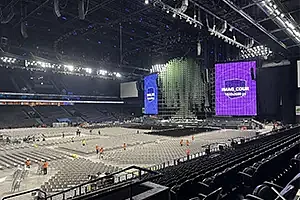
One of the first challenges in a venue of this size is quite clear: maintaining stable wireless coverage when transmitters may be located in very different areas of the pitch.
The production used 12 channels of Axient Digital PSM for in-ear monitoring, together with ADX transmitters and AD4Q digital receivers operating with Quadversity. Eight additional channels were also used in a Quadversity configuration through the scalable ANX4 receiver.
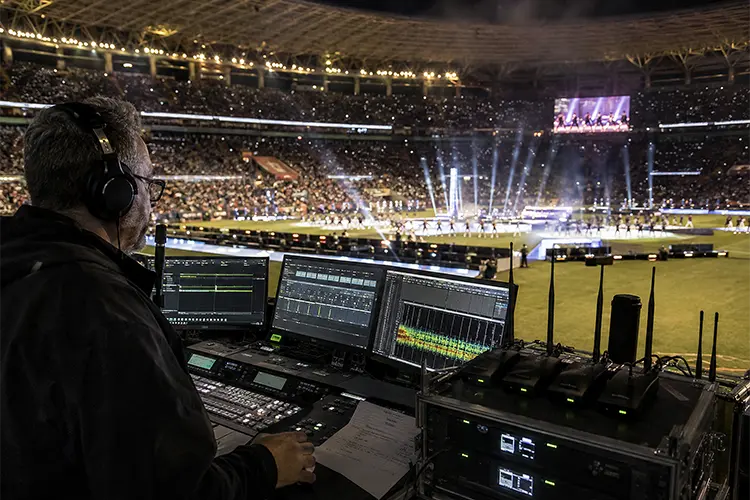
Quadversity is particularly useful in this type of application. The system makes it possible to work with four antenna zones per receiver instead of relying solely on a single pair of antennas.
In a stadium, this makes it possible to distribute reception zones strategically and reduce the areas where a transmitter could be compromised by distance, obstacles or propagation conditions.
It is not simply a matter of adding antennas: RF coverage is designed around the area in which the performer will be moving.
ShowLink: adjusting a transmitter without reaching the performer
The second interesting aspect was remote management. ShowLink allowed the team to control the Axient Digital transmitters deployed on the pitch from a central position. Technicians could change parameters, check their status and respond to changes during the production itself.
Jim Van Winkle, General Manager of PWS, clearly summarises the practical advantage: the ability to adjust the microphones from a single position reduced the time needed to respond when something changed during the show. This is probably one of the lessons that can be most easily applied to other productions.
At a conventional concert, it may still be possible to physically access a transmitter. At a televised ceremony, in a large stadium or during a production with extremely tight timings, the ability to intervene remotely becomes part of the system’s overall safety strategy.
Eight audio channels from a single location
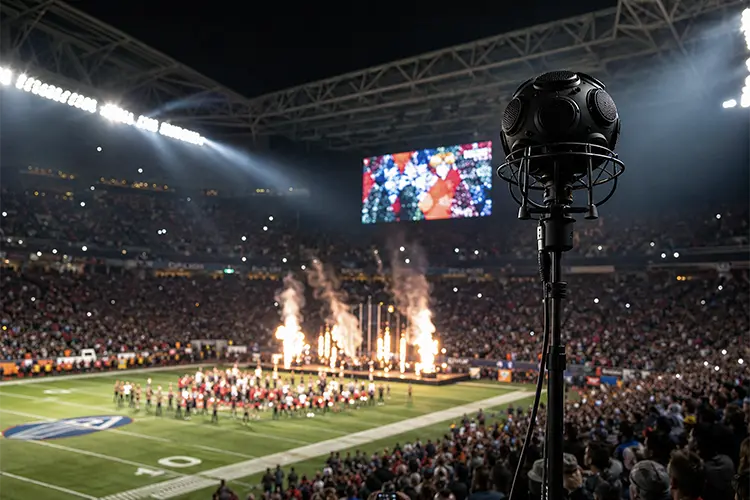
The most interesting part from a broadcast perspective came from the Shure DCA901 Broadcast Microphone Array. The broadcast team used it to capture the atmosphere inside the stadium and generate part of the immersive mix for the television feed.
According to production audio supervisor Tom Holmes, a single DCA901 provided eight independent audio channels from one physical location.
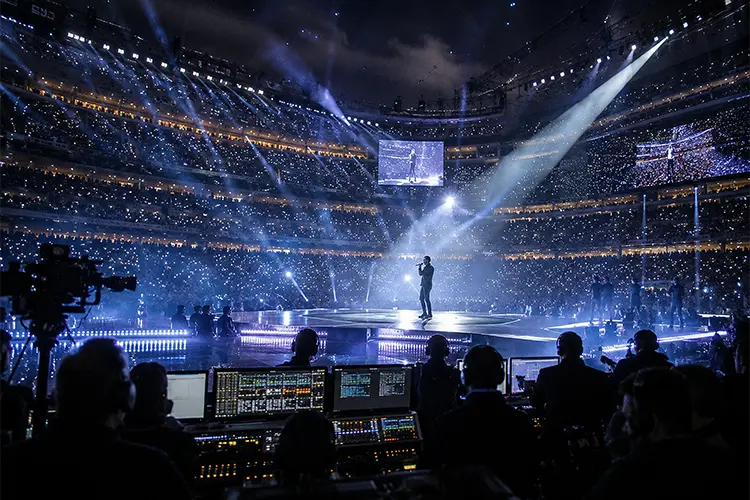
Its pickup lobes could be aimed remotely, allowing the engineer to adjust the areas they wanted to hear in real time without having to physically move the microphone.
In this production, those eight channels were used to feed the height sources of the immersive mix. It is an interesting broadcast approach because it breaks with the traditional relationship of “one listening position, one microphone”.
A steerable array makes it possible to capture different areas from the same device and subsequently adjust the direction from which the sound is being picked up.
Fewer microphone positions, less cabling and less time
The other advantage was purely practical. The DCA901 combined audio, power and control over a single network connection, reducing both cabling and the need to install multiple microphones around the stadium.
In large productions, this type of simplification is more important than it might appear.
Each additional microphone position requires cabling, infrastructure, installation time, checks, consideration of potential interference with cameras or the audience, and another element that must be monitored during the broadcast.
Therefore, more important than the number of channels the array can provide is the number of physical positions it eliminates the need to deploy.
From the stage to the broadcast
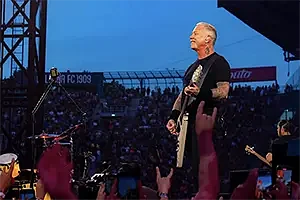
The system simultaneously met the needs of both the performers and the television production. Coldplay’s Chris Martin used an SM58 capsule with an Axient Digital AD2 transmitter. The SM58 celebrates its 60th anniversary in 2026. Burna Boy also used Axient Digital, while Jason Sudeikis and Brendan Hunt, appearing as Ted Lasso and Coach Beard, and Justin Bieber used Shure SM39 headset microphones. However, the most relevant aspect of the installation is probably not which microphone each performer used.
What is interesting is how wireless microphones, in-ear monitoring, remote management, a distributed RF infrastructure and multichannel capture for immersive audio all worked together within the same production.
What can be learned from a stadium
Major sporting events provide an excellent testing ground for wireless audio because they bring together challenges that arise separately in smaller installations.
Coverage must be planned, frequencies coordinated, dead zones minimised and transmitters monitored, while simultaneously providing independent audio for the audience, performers and broadcast.
The production of this final also reveals a clear trend: an increasing number of decisions are moving from the physical level to the control level.
Antennas are distributed across different zones, transmitters are configured remotely and a single broadcast array can generate different pickup areas without moving the hardware.
The result is not simply the use of fewer devices. It involves designing an infrastructure that can adapt quickly when the production changes, something particularly valuable when there is no possibility of repeating the performance.