


At Grace Church in Seattle, upgrading the sound system meant solving two equally important challenges: improving intelligibility throughout the sanctuary while preserving the visual character of the space.
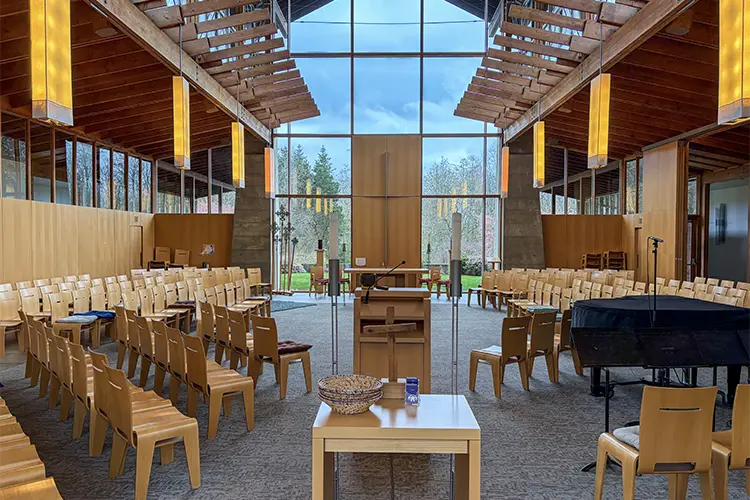
The church sanctuary features a narrow layout, vaulted wood ceilings, large glass windows and a center aisle that functions as a flexible area for liturgy, music, weddings and special events. The pastor regularly walks and speaks throughout this central area, making consistent coverage and effective feedback control essential to the design. At the same time, the church wanted the loudspeakers to remain as visually discreet as possible, keeping the focus on the architecture, the service and the congregation’s experience.
The installation was designed and integrated by Viation, which worked with 1 SOUND to develop a solution tailored to the church’s architectural and acoustic challenges.
We were basically being asked to perform magic. They wanted a high-performance sound system that would also go completely unnoticed, said John Wilson, President of Viation.
Viation developed a custom design approach centered around Cannon C8 point source systems with custom-matched wood finishes. Rather than using larger loudspeakers with long-throw characteristics, the system was designed as a distributed installation using multiple compact loudspeakers placed throughout the sanctuary.
This approach helped minimize reflections and excessive reverberation within the reflective architectural environment while maintaining intelligibility in both the seating areas and the center aisle. The controlled dispersion characteristics of the Cannon Series also helped focus sound energy on listeners while avoiding unnecessary excitation of the vaulted ceilings and glass surfaces.
The benefit of the Cannon Series was keeping the sound focused on the people where it was needed, without blasting it everywhere, explained Wilson.
The final system deploys rows of Cannon C8 loudspeakers along both sides of the sanctuary, spaced approximately 4.5 meters apart and mounted along the exterior of the beams with minimal visibility. Angled to follow the geometry of the beams and optimize coverage, the loudspeakers disappear into the architecture while maintaining consistent sonic performance throughout the room.
Adjacent spaces within the church utilized Cannon C5 loudspeakers, while Powersoft amplification powered the system throughout the installation. “Several people came up during the installation asking, ‘Where are the speakers?’” Wilson recalled. “They completely disappear”.
The distributed approach also allowed the system to be time-aligned so that speech and music maintained a natural sense of localization throughout the sanctuary, helping attendees feel connected to the person speaking rather than to the sound system itself.
Despite initial discussions about adding subwoofers, the final installation relied on the Cannon C8 loudspeakers for low-frequency reproduction. According to Wilson, the result delivered more than enough low-end extension for the space while maintaining balance within the highly reflective environment.
Following the first service with the new system installed, the impact was immediately evident. “One of the parishioners came up and said it was the first time he had been able to hear an entire sermon in the 10 years he had been attending there”, shared Wilson.
For the church team, the upgrade transformed not only the clarity of the space, but also the overall functionality of the sanctuary for worship, music and events.
I’m pleased with the final result. Operationally for the church team, it was the same as operating the previous system, except now they had a much better canvas to work with, said Wilson.