Nvidia has expanded its AI for Media technology suite at IBC 2026, aimed at audiovisual production, broadcast and streaming. The new developments focus on incorporating artificial intelligence directly into workflows to analyse, verify and enhance video content in real time.
The offering brings together software development kits, microservices and reference architectures that can be integrated into production and distribution applications. Potential uses include detecting AI-generated videos, enhancing image quality, creating smoother replays and adapting content into different languages.
Detection of AI-generated videos
One of the tools included is Nvidia Synthetic Video Detector, designed to assess the probability that footage is authentic or has been generated using artificial intelligence.
The technology does not determine on its own whether content is real or false. Its purpose is to provide additional information, such as confidence scores and signals detected within individual frames, which editorial, verification and compliance teams can incorporate into their review processes.
Dalet is integrating this capability into a cloud-hosted verification environment. This will allow news organisations to submit videos for analysis and view the results and metadata through a single interface.
Wowza also plans to incorporate the tool into its video intelligence platform to analyse live broadcasts and identify objects, scenes or possible signs of AI-generated content.
Image enhancement and smoother replays
The new developments also include technologies designed to improve video quality.
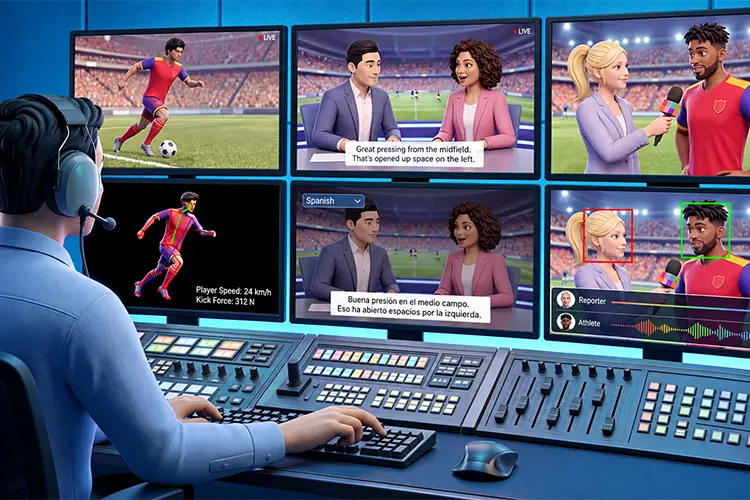
Video Frame Generation uses generative artificial intelligence to create intermediate frames between the original ones. This process can increase the frame rate and produce smoother motion in sports content, live broadcasts and slow-motion replays.
Ross Video is incorporating this technology into its Rio Replay platform to generate AI-assisted sports replays. The system aims to produce smoother motion without relying exclusively on cameras capable of recording every frame at a very high frame rate.
Meanwhile, Video Super Resolution can increase resolution and reduce elements such as noise, blur and compression artefacts. It can be used in video players, streaming services, broadcast systems, videoconferencing applications and transcoding processes.
These capabilities are complemented by TrueHDR, which converts standard dynamic range video into high dynamic range content in real time. The three technologies can be combined within a single processing pipeline.
Motion analysis using a single camera
Nvidia has also developed body pose estimation technology capable of identifying the positions and angles of joints from video recorded with a single camera.
The resulting information can be used for motion tracking, biomechanical analysis, replay enhancement, officiating and the creation of virtual experiences. It can also be applied to animation and virtual production by transferring detected movements to compatible digital characters.
Vizrt uses this technology in virtual studio environments to link body movement with three-dimensional lighting effects, shadows and reflections.
Live content localisation
Another area addressed is the adaptation of programmes for different languages and markets. Localisation technologies can combine subtitles, translated audio, dubbing, synchronised lip movements and adapted graphics.
The LipSync system modifies a person’s mouth movements to match a translated audio track while preserving other elements of the image, such as head position and blinking.
An active speaker detection function is also included to identify who is speaking in scenes involving several people. NDI is using these capabilities to develop real-time translation and synchronised dubbing processes within broadcast environments.
Integration into software-based infrastructures
The incorporation of Media Exchange Layer into Nvidia Holoscan for Media aims to facilitate connections between video, audio and data applications within distributed production environments.
This architecture allows different functions to share the same infrastructure and evolve independently. For broadcasters and technology providers, its potential lies in reducing the number of custom integrations required to connect individual applications.
Implementing these tools also raises questions concerning technical complexity, processing resources and dependence on a particular infrastructure. Their adoption will therefore depend on the specific requirements of each workflow and the benefits they offer compared with existing systems.