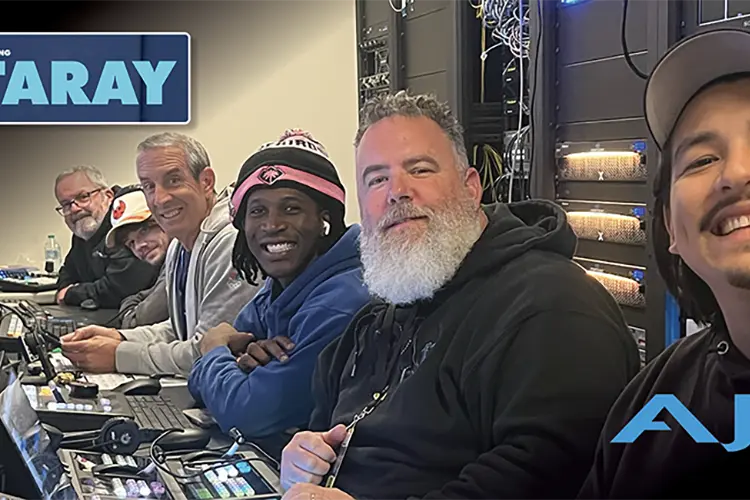
Bantaray Mobile Sports Production uses AJA FiDO mini-converters to transmit video and audio signals over long distances via fiber optics, enabling connections between cameras, mobile production units, and commentary booths during sports broadcasts.
The growth of streaming platforms is expanding broadcasting opportunities for specialized sports such as athletics and pickleball. These productions face technical challenges similar to those of major sports broadcasts, particularly regarding signal transport, equipment synchronization, and adapting to different venues.
Steve Banta, founder of California-based Bantaray Mobile Sports Production, and Jeff Highbaugh, a freelance camera operator who regularly works with the company, have developed a mobile production infrastructure that uses AJA FiDO mini-converters to convert signals between SDI and fiber optics.
The solution extends transmission distances and distributes audiovisual signals between different production locations while maintaining the flexibility required to work in venues with widely varying configurations.
Fiber optics connect cameras, mobile production units, and commentary booths
Bantaray's workflow begins with deploying the fiber-optic infrastructure. Once the equipment is installed, the technical crew conducts rehearsals, produces the event, and subsequently dismantles the system.
One of the main challenges is that visiting venues before every production is not always possible. To plan installations, the team uses tools such as Google Earth to examine venue layouts and identify potential locations for the mobile production unit.
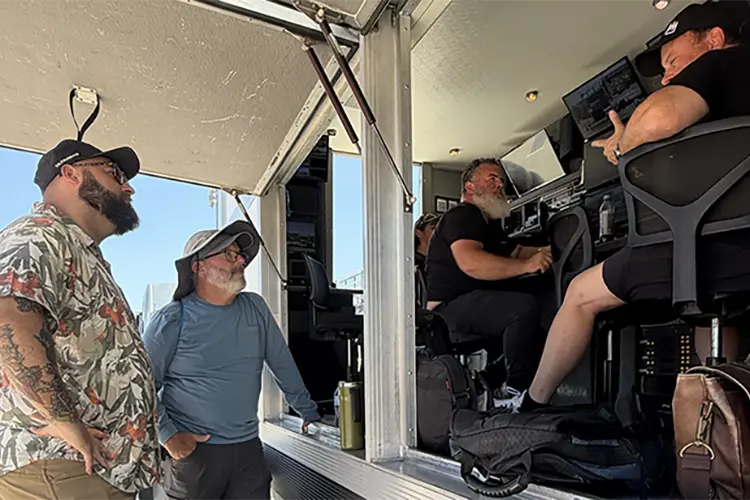
According to Highbaugh, using fiber optics provides greater freedom when positioning production equipment without being constrained by the distance limitations of conventional SDI cabling.
That's the advantage of fiber optics. We can park the mobile production unit anywhere at the venue and quickly deploy audio and video connections using our FiDO converters, linking as many fiber runs as necessary, he explains.
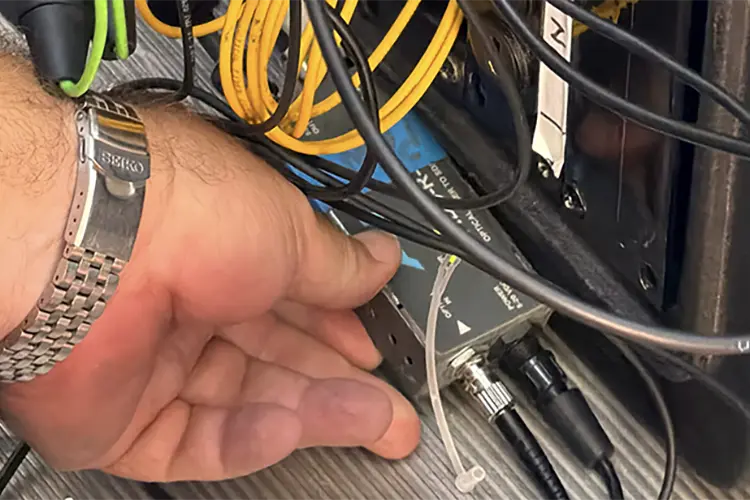
Bantaray has approximately 24 AJA FiDO mini-converters, including the -4T, -4R, -2T, -2R, -R, and -T models. These devices are integrated into a portable kit designed for commentary booths, which also includes an input/output patch panel and audio equipment.
To establish the connection to the commentary booth, the company uses a four-pair tactical fiber-optic cable capable of carrying multiple audiovisual signals. "Setup is very quick, and we can transport signals from four cameras over a single fiber-optic line", Highbaugh explains.
In addition to FiDO converters, the company uses other AJA mini-converters to convert SDI signals to HDMI for monitoring, as well as distribution amplifiers and Ki Pro recorders.
Long-distance signal transport and synchronization
The distance between different production locations represents one of the main technical challenges in sports broadcasting.
Bantaray typically works with a mobile production unit and a commentary booth, where a significant proportion of the video and audio connections are concentrated. Depending on the event, signals must also be distributed to scoreboards and LED displays installed throughout the venue.
The company has fiber-optic cable reels measuring up to approximately 305 meters and frequently uses Dante technology for audio transport.
Steve Banta explains that fiber optics make it possible to connect multiple cable runs to cover greater distances, using FiDO converters at the endpoints.
Another fundamental consideration is latency, particularly in remote productions where cameras, commentators, and the production team may be located in different geographical locations.
We regularly produce games where the cameras are in one state, the commentators are somewhere else, and the production team works remotely from a third location. Everything must remain synchronized so viewers are unaware of the technical complexity behind the broadcast, Banta explains.
To reduce operational risks, Bantaray's founder favors using dedicated hardware, avoiding the concentration of too many functions in a single device.
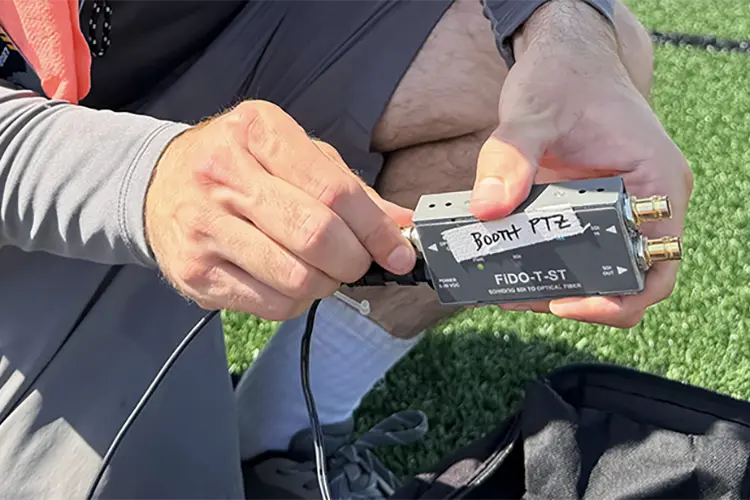
Cable routing also requires careful planning to ensure the safety of athletes and spectators, particularly when connections must cross different areas of a venue.
Reliability in live sports production
Equipment reliability is another determining factor in Bantaray's workflow. The company produces broadcasts with small crews, where each professional typically performs multiple roles.
In this context, the company considers it essential to have devices that provide stable, straightforward signal conversion without adding complexity to the setup.
"Our AJA FiDO mini-converters provide reliable conversion between SDI and fiber optics. We don't have a huge crew, and everyone performs multiple roles, so we need reliable, consistent, and easy-to-use equipment to achieve the best possible quality on every broadcast", Highbaugh says.
Bantaray has completed dozens of broadcasts for Spectrum and more than one hundred remote baseball productions using its technical infrastructure.
According to Banta, the FiDO converters have demonstrated their durability under demanding working conditions, including rainy days, extreme temperatures, and frequent travel.
Reliability is everything in live production. Our FiDO converters have performed in rain, extreme heat, and through constant travel. It's better to invest in reliable equipment than to continually troubleshoot problems caused by cheaper alternatives, he says.
Remote production, SMPTE ST 2110, and HDR
The evolution of remote workflows is one of the main technology trends Bantaray is following.
According to its founder, the pandemic accelerated the adoption of systems that allow events to be produced without bringing all professionals together in a single mobile production unit. These solutions have continued to evolve ever since.
The company is also closely monitoring IP-based production technologies, particularly the SMPTE ST 2110 standard, as well as the increasing adoption of high dynamic range (HDR) in sports broadcasting.
Although Bantaray operates in 1080p SDR, the company recently participated in a basketball production in which an existing mobile production unit was upgraded to support HDR using AJA FS-HDR equipment.
Highbaugh, meanwhile, emphasizes the importance of developing systems capable of efficiently transporting high-quality, low-latency signals, even in environments with limited bandwidth or remote locations.
The growth of sports streaming is also creating new opportunities for companies specializing in multi-camera production and mobile broadcasting.
In this area, Banta is currently developing the internal production infrastructure for live shows and concert broadcasts at Acrisure Arena in Thousand Palms, California.
AJA FiDO: SDI-to-fiber conversion
AJA FiDO mini-converters are designed to facilitate the transport of 12G-SDI, 6G-SDI, and 3G-SDI signals over fiber optics, providing a compact solution for professional audiovisual production applications.
Single-mode fiber models support connections of up to 10 kilometers, while versions compatible with optional multimode SFP modules support distances of up to 700 meters over OM4 fiber and 300 meters over OM3 fiber. Their compact, low-profile design makes installation easier in space-constrained environments such as equipment racks, mobile production units, and camera systems.
These features enable the converters to be integrated into mobile production infrastructures that require long-distance connections and flexible configurations adaptable to different venues.
 Instagram
 Facebook
 LinkedIn
 YouTube